
Hyaluronic Acid for Mature Skin: The One Ingredient Skin Truly Needs
Hyaluronic acid for mature skin is often discussed as a plumping or anti-ageing ingredient, but its most important role is far more fundamental than smoothing fine lines.
When people talk about mature skin, the focus almost always goes straight to wrinkles and retinol.
Retinol absolutely has a place. Used well, it can support skin renewal over time.
But what’s often overlooked is this.
The most consistent issue in mature skin isn’t wrinkles first: It’s hydration.
Mature skin isn’t just lined. It’s dehydrated.
And if hydration isn’t addressed first, even the most effective wrinkle-focused products struggle to deliver the results people expect.
This is why hyaluronic acid for mature skin remains one of the most valuable tools in any routine when it is formulated correctly and used consistently.
Think about grey hair for a moment
Grey hair isn’t only grey.
It has a completely different texture.
It’s drier
Coarser
Less elastic
Harder to manage
You can use the best conditioner in the world, but the underlying issue remains. The hair fibre itself doesn’t hold moisture the way it used to.
Skin behaves in a very similar way as it matures.
The issue isn’t just surface appearance. It’s a fundamental change in how skin manages water, stores hydration, and repairs itself after daily stress.
This is where hyaluronic acid for mature skin becomes essential, not optional.
So what actually changes in mature skin
Hyaluronic acid is a naturally occurring component of the skin. It plays a key role in hydration, elasticity, and overall skin quality.
As skin ages:
- Natural hyaluronic acid levels decline
- The skin’s ability to retain water decreases
- Barrier repair slows
- Skin becomes less elastic and more fragile
Dermatological research consistently links age-related changes in hyaluronic acid and other glycosaminoglycans with reduced hydration and altered skin mechanics.
This is why mature skin often:
- Feels tight even after moisturising
- Looks crepey rather than simply wrinkled
- Loses bounce before it loses firmness
These are hydration problems first.
This is also why products focused solely on exfoliation or stimulation often leave mature skin feeling worse over time.
Why is hyaluronic acid important for mature skin
Hyaluronic acid for mature skin is important because it helps compensate for age-related water loss, improves skin comfort, supports elasticity, and enhances barrier function without irritation.
Why hydration matters more than surface level lines
Much of what we perceive as “ageing” day to day is dehydration layered on top of structural change.
When skin is under-hydrated:
- Fine lines appear deeper
- Texture becomes rougher
- Skin reacts more easily
- Recovery slows
Hydrated skin behaves better. It is more flexible, more comfortable, and more resilient.
Improving hydration alone often makes skin look healthier before any corrective treatment is introduced.
Hydration isn’t cosmetic
It’s functional
This principle also connects directly to long-term skin resilience and skin longevity, a core concept explored in more depth here.
What hyaluronic acid actually does
Hyaluronic acid is water soluble. Its role is to bind and manage water within the mid to upper layers of the skin.
Topically, it helps to
Improve skin hydration
Support elasticity and comfort
Enhance surface smoothness and plumpness
However, how well hyaluronic acid for mature skin performs depends entirely on formulation, molecular size, and what surrounds it in the formula.
Why molecular weight matters
Not all hyaluronic acid behaves the same way.
Scientific studies show that molecular size affects how hyaluronic acid interacts with the skin
Larger molecules mainly hydrate the surface and improve softness and plumpness
Smaller molecules can penetrate further into the upper skin layers and support deeper hydration
Using more than one molecular size allows hydration to be delivered at different levels, rather than relying on a single mechanism.
This layered hydration approach supports mature skin without overwhelming it.
Why nano-weighted hyaluronic acid is avoided, especially for sensitive skin
While smaller hyaluronic acid molecules can be beneficial, ultra-small or nano-weighted hyaluronic acid behaves differently.
Very small fragments can interact more actively with skin cells and immune pathways. In scientific literature, these fragments are sometimes associated with pro-inflammatory signalling, particularly in compromised or sensitive skin.
In simple terms
Hyaluronic acid is meant to hydrate the mid and upper skin layers
Pushing it too deeply doesn’t improve hydration
In some skin types, it can increase irritation rather than calm it
For mature skin especially, calm, supportive hydration consistently outperforms aggressive penetration.
This aligns with Biobod’s broader barrier-first and stress-reduction philosophy, which also overlaps with emerging skin biohacking conversations.
Why formulation matters more than the ingredient list
Hyaluronic acid needs water to function properly.
When it’s locked into heavy, oil-rich creams, it can struggle to move freely into the skin. These formulas may feel comforting, but they primarily work by sealing the surface rather than delivering hydration.
A water-based, oil-free serum allows hyaluronic acid and other humectants to reach the skin before anything occlusive sits on top.
Think of it as
Hydrate first
Seal second
This approach is especially important for mature skin where barrier repair is slower.
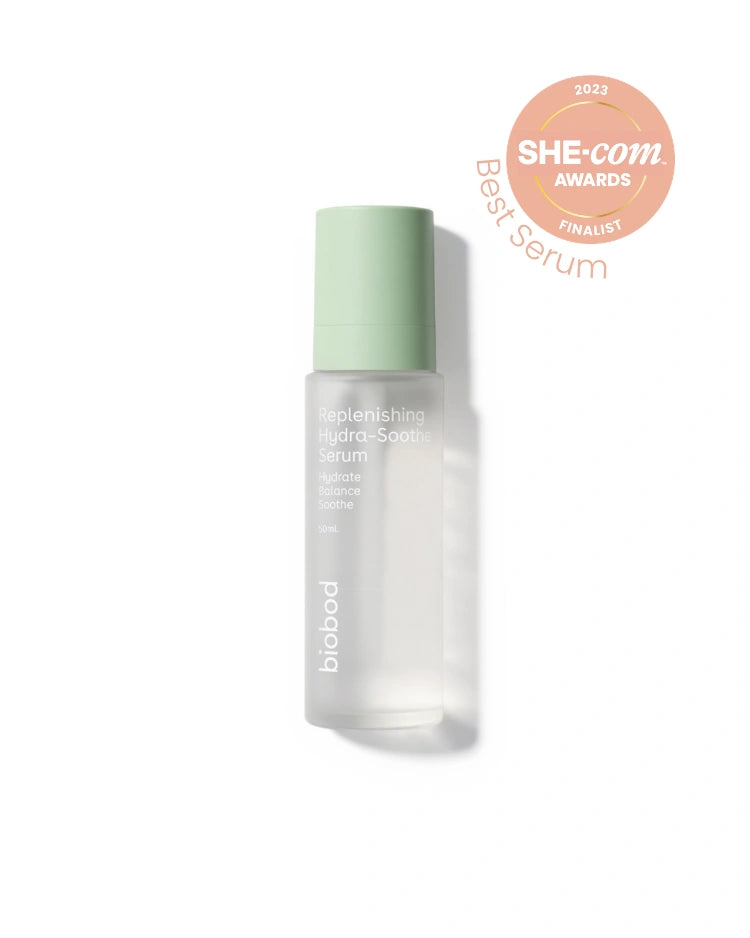
Why Replenishing Hydra-Soothe Serum works so well for mature skin
Our Replenishing Hydra-Soothe Serum was designed specifically around the hydration needs of mature and sensitive skin.

It works on three levels
Oil-free delivery
Hydration can reach the skin without being blocked. The serum sits weightlessly under moisturisers, oils, sunscreen, and makeup, making it ideal for daily use.
Carefully selected hyaluronic acid
Sodium Hyaluronate provides effective hydration without irritation, supporting skin comfort and elasticity with consistent use.
A hydration matrix that mirrors skin physiology
The formula includes
Glycerin to support long-term hydration and barrier recovery
Betaine to maintain hydration balance and reduce sensitivity
Sodium PCA to support the skin’s natural moisturising system
Inulin as a prebiotic to support microbiome balance
Lactic Acid as a postbiotic to help maintain skin equilibrium
Each binds water differently. Together, they deliver long-lasting hydration without heaviness, shine, or stickiness.
This makes Hydra-Soothe a true base layer product. With regular use, it improves how skin responds to everything applied afterwards.
What is the best way to use hyaluronic acid for mature skin
The best way to use hyaluronic acid for mature skin is on clean, slightly damp skin, followed by a moisturiser or oil to seal hydration and support barrier function.
Why consistent use matters
Hyaluronic acid for mature skin is not a quick fix. It works cumulatively.
With consistent daily use, skin becomes
More comfortable
Less reactive
More resilient
Better able to hold hydration on its own
This is how hydration supports long-term skin health rather than just short-term plumping.
Mature skin doesn’t just need surface-level wrinkle care.
It needs deep, well-delivered hydration.
Hyaluronic acid for mature skin remains one of the most effective and science-backed hydration tools available when
Molecular size is chosen carefully
Penetration is controlled, not forced
Hydration is treated as a system, not a single step
When hydration is respected, the skin functions better. And when skin functions better, everything else works more effectively too.
References
Papakonstantinou E, Roth M, Karakiulakis G.
Hyaluronic acid A key molecule in skin aging. Dermato-Endocrinology. 2012.
https://www.ncbi.nlm.nih.gov/pmc/articles/PMC3583886/
Farage MA, Miller KW, Maibach HI.
Degenerative changes in aging skin. British Journal of Dermatology. 2008.
https://pubmed.ncbi.nlm.nih.gov/18333893/
Rawlings AV, Harding CR.
Moisturization and skin barrier function. Dermatologic Therapy. 2004.
https://pubmed.ncbi.nlm.nih.gov/15327470/
Essendoubi M, et al.
In vivo assessment of the penetration of hyaluronic acid of different molecular weights. Skin Research and Technology. 2016.
https://pubmed.ncbi.nlm.nih.gov/26386056/
Stern R, Maibach HI.
Hyaluronan in skin Aspects of aging and its pharmacologic modulation. Clinical Dermatology. 2008.
https://pubmed.ncbi.nlm.nih.gov/18472055/
Fluhr JW, et al.
Glycerol and the skin A holistic approach to its origin and functions. British Journal of Dermatology. 2008.
https://pubmed.ncbi.nlm.nih.gov/18489596/
Litwiniuk M, et al.
Hyaluronic acid in inflammation and tissue regeneration. Wounds. 2016.
https://pubmed.ncbi.nlm.nih.gov/26978861/
Jokura Y, et al.
Skin irritation prevention by betaine in surfactant systems. Journal of Cosmetic Science. 1998.